
Creating the NEV | LSV
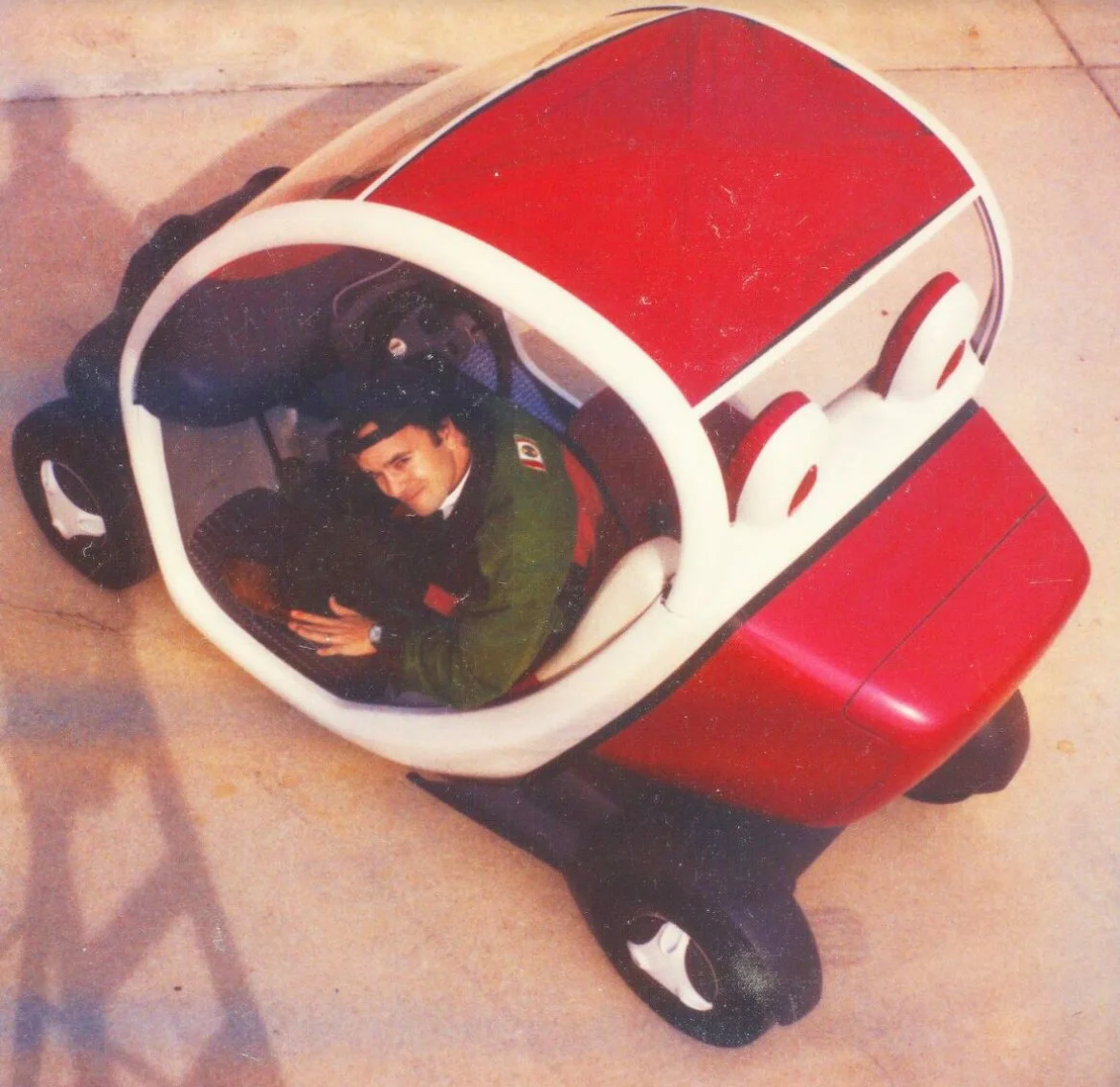
My / our first (non-folding) trans2 prototype - 1993Long before “micromobility” became a buzzword, I was working on a much more basic question: why are Americans forced to use oversized cars for short, everyday trips?
In 1988, I left GM to pursue a very different kind of vehicle — small, enclosed, electric, and designed specifically for neighborhood travel. I started with Caleb, Inc., then brought in additional partners to form trans2. What we were trying to do was not just build a quirky little car. We were trying to prove that there was a whole missing category of transportation between the Vespa scooter and the conventional automobile.
That effort was far harder than it may look in hindsight. Getting a new vehicle idea to production is always difficult. Getting an entirely new type of vehicle taken seriously was another level of challenge altogether. But we kept pushing — in design, engineering, manufacturing, and policy.
In 1992, my partners and I approached NHTSA to help make the case for a new federal category for these vehicles. That effort helped lead to the creation of the Low-Speed Vehicle, or LSV, category — an important step that gave legal and regulatory recognition to a form of transportation that had barely existed in the American imagination.
Then, in 1995, the idea finally reached production. The company became GEM, and what had once seemed improbable became real: America’s first Neighborhood Electric Vehicle. It was a breakthrough not just for our team, but for the larger idea that many daily trips could be served by something lighter, smaller, cleaner, and more practical than a standard car.
That original vision now looks less radical than it did back then. What was once dismissed as marginal is increasingly recognized as necessary. Even major brands are now entering the space. Fiat, for example, is currently marketing the Topolino in the United States as a low-speed vehicle for 2026, a reminder that this category has moved from the edge toward the mainstream.
The vehicle I helped bring into the world lives on today as GEM, though it has since been updated and redesigned. I’m proud to have been there at the beginning — helping imagine it, shape it, fight for it, and finally see it reach the road.