
What is a wheelprint?
The mobility mesh is an alternative to automobile ownership. The user accesses their world virtually, lives in good proximity to things, and gets their mobility on demand. This is a meshr. Having a good mesh enables people to own a smaller vehicle for most trips. Let’s calculate how much less land the meshr uses vs. the big car owner.
Wheelprint = the amount of ground area a person’s mobility setup occupies × how long it occupies that area.
Units = sqft·hours (square-feet × hours).
If something sits on 300 sq ft for 24 hours, its daily wheelprint = 300 × 24 = 7,200 sqft·hours.
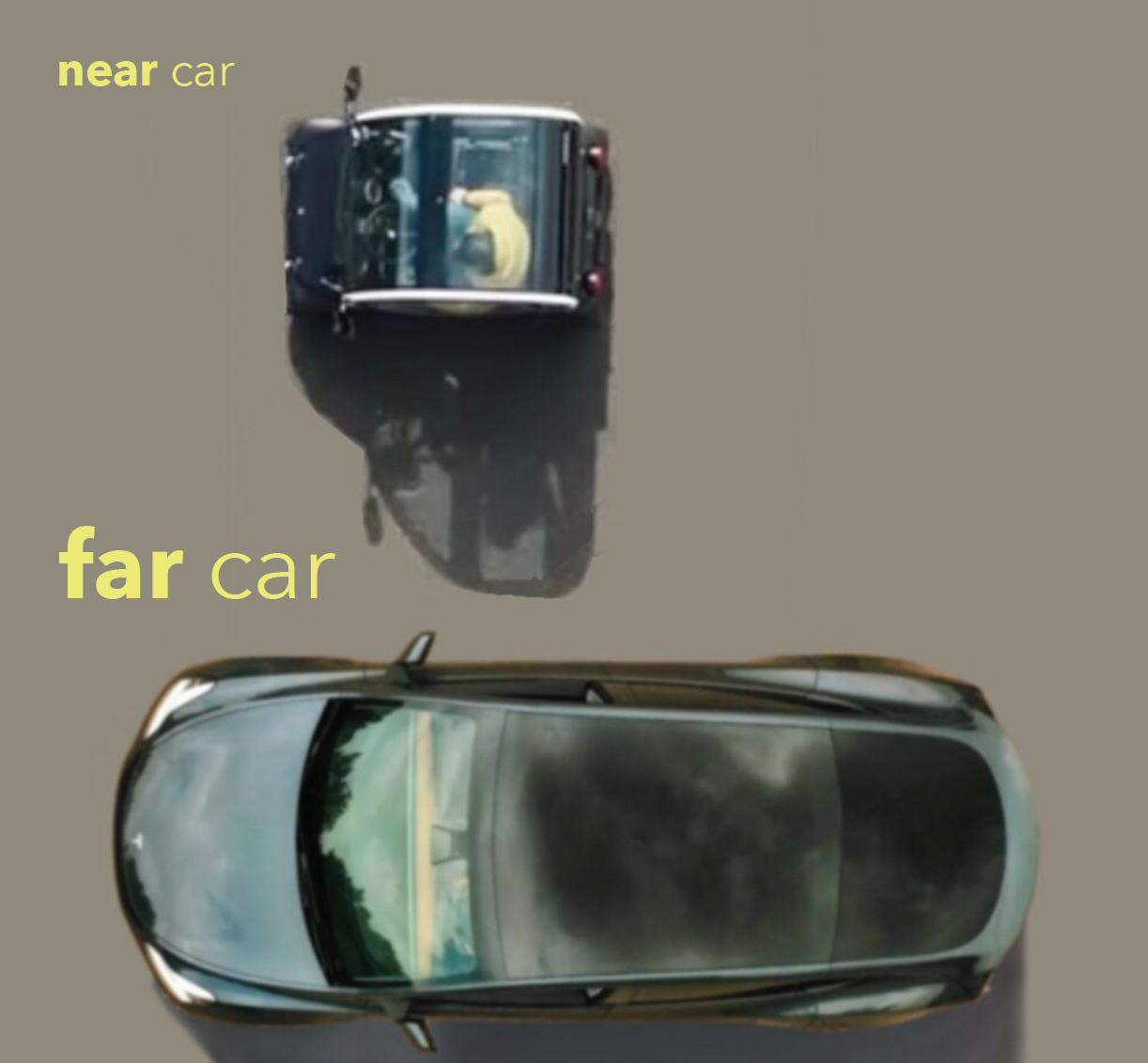
Top view of a Biro near car (size of a golf cart), called NEV or LSV in USA, and a Tesla. This comparison below is with an eBike owner - which is smaller than the near car. If the near car is owned, the sgft•hours will be higher, but less than owning the Tesla
Teaching someone about wheelprints
Imagine you draw the car as a 300-square-foot mat on the ground. If you own the car, you keep that mat under you all day — it never leaves. One meshr, instead, might keep a very small mat (an eBike mat) — one-tenth the size. When they need a car ride, they borrow a car for a short time, which temporarily puts a big mat down for only that half hour. If they do that only a few times a month, the total “mat time” the meshr causes is far less than the car owner’s constant big mat.
Calculate the land needed - over time for an eBike owner + mesh user (public transit, Uber and robotaxis, etc.) vs. big car owner.
Side-by-side comparison: meshr (with eBike) vs. automobile owner:
Yearly
Car owner: 2,592,000 sqft·hours
Meshr: 291,960 sqft·hours
Same ~11.3%.
Average continuous footprint
Car owner: 300 sqft
Meshr: ~34 sqft
So under these assumptions a meshr’s wheelprint is about one-ninth of a traditional car owner’s wheelprint. (A meshr that gets an eBike on demand and does’t own it - their wheelprint will be even smaller).
Meshr is ~11.3% of the car owner’s wheelprint (24,330 / 216,000 ≈ 0.1126).
Short takeaway
Owning a big car ≈ 300 sqft always → large wheelprint: 216,000 sqft·hours/month.
Meshing with an eBike + shared robotaxis + transit → ~24,330 sqft·hours/month, ~11% of the car owner’s wheelprint.
In steady terms that means the meshr’s average continuous footprint is ~34 sqft vs the car owner’s 300 sqft.
——————————————————
Math + assumptions
Big car footprint = 300 sq ft (parked / standing area - takes up space driving too).
eBike footprint = 30 sq ft (≈1/10 of car).
Car is operating or parked 24 hours/day (owner always keeps it nearby when parked).
eBiker (the “meshr”) stores their eBike nearby 24 hours/day.
Robotaxi / Uber / Waymo vehicle footprint while in use = 300 sq ft (same physical space as a big car).
Robotaxi rides: 15 rides / month, each 0.5 hour (30 minutes).
Transit (bus/rail) use: 30 hours / month, average vehicle is 50% full.
For bus/train I’ll assume a vehicle footprint of ~320 sq ft (typical long bus), and 50% full ≈ 20 passengers → per-rider footprint ≈ 16 sq ft while riding.
A month = 30 days, so 1 month = 30 × 24 = 720 hours.
The math with these numbers.
Step 1 — Car owner wheelprint
Car owner keeps car (300 sq ft) nearby 24/7:
Monthly:
300 sqft x times 24/day x 30 days = 300 x 720 = 216 sqft·hoursYearly:
216 x 12 = 2,592,000 sqft·hours / year
Average constant area (monthly total ÷ 720 hours) = 216,000 ÷ 720 = 300 sqft (obvious: the car is always there).
Meshr (eBike + occasional robotaxi + transit)
Broken into parts.
eBike (stored or operating) 24/7
Monthly: 30 sqft x 720 hr = 21,600 sqft·hoursRobotaxi rides (15 × 0.5 hr × 300 sqft)
Monthly: 15 x 0.5 hr x 300 sqft = 15 x 150 = 2,250 sqft·hoursBus/rail (30 hr/month at 16 sqft per rider)
Monthly: 30 hr x 16 sqft = 480 sqft·hours
Add them up:
Meshr monthly total = 21,600 + 2,250 + 480 = 24,330 sqft·hours / month
Yearly: 24,330 \times 12 = 291,960 sqft·hours / year
Average constant area = 24,330 ÷ 720 ≈ 33.8 sqft (so on average the meshr “uses” ~34 sqft of space continuously).
Sensitivity / alternative scenarios (quick examples)
If a meshr doubles robotaxi rides to 30 rides/month (still 0.5 hr each): robotaxi part = 30×0.5×300 = 4,500 sqft·hours → total monthly ≈ 21,600 + 4,500 + 480 = 26,580 → still ~12.3% of car owner.
If meshr also borrows the far car twice a month for day trips (2 × 4 hr = 8 hr/month): added = 8×300 = 2,400 sqft·hours → new total ≈ 24,330 + 2,400 = 26,730 → ~12.4% of owner.
If a bus/train occupancy is worse (25% full) per-rider area doubles (≈32 sqft), transit part = 960, total ≈ 24,810 → still ≈11.5%.
So the result is robust: even with more robotaxi trips or occasional car borrows, the meshr wheelprint stays an order of magnitude smaller unless they start using big cars many hours per month.